EEG neurofeedback in children has established itself as a promising treatment option in recent years, particularly for attention disorders and concentration problems. The method enables children to learn to consciously influence certain brain wave patterns through direct feedback on their brain activity. While the therapy has shown positive effects in many young patients, there are also critical voices regarding the scientific evidence. Parents and therapists should have realistic expectations and consider the method as one possible component of a comprehensive treatment concept. This text highlights how neurofeedback works, its areas of application and current research findings.
What is EEG neurofeedback and how does it work?
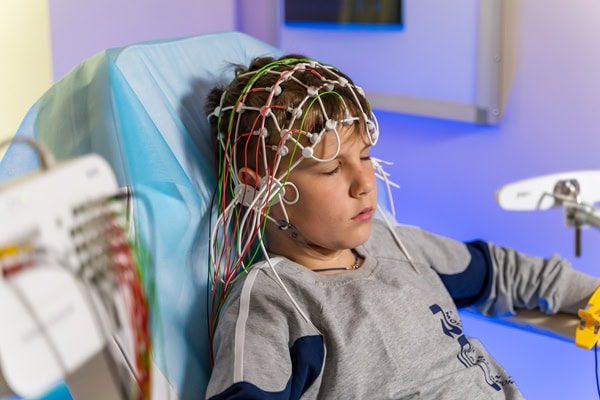
Neurofeedback is a form of biofeedback in which the electrical activity of the brain is measured and fed back to the patient in real time. Electrodes are placed on the scalp and connected to an electroencephalograph (EEG). This device records the brain waves, which are then displayed as visual or acoustic signals.
The basic idea is simple: children watch a film or play a game on a screen, for example, which changes when their brain activity shows a certain desired pattern. If the child is attentive and produces the right brain waves, the film continues or the game runs smoothly. If the patterns are undesirable, the film stops or the game becomes more difficult. Through this immediate feedback, the brain gradually learns to produce more favourable activity patterns more frequently.
EEG training for the brain is based on the principle of operant conditioning. The brain is rewarded for desired behaviour and thus learns to repeat this behaviour. In contrast to conscious learning, this process takes place largely unconsciously – the brain optimises itself through repeated feedback.
EEG neurofeedback: areas of application in children
EEG neurofeedback is used for various indications in children. The method is most commonly used for attention deficit hyperactivity disorder, but other areas may also benefit from this form of therapy.
ADHD as the main area of application
Children with ADHD typically show certain abnormalities in their brain wave patterns. Often, there are increased theta waves, which are associated with daydreaming and inattention, as well as decreased beta waves, which are related to focused attention. The effectiveness of neurofeedback in ADHD aims to correct this imbalance.
During treatment, children learn to reduce their theta activity while increasing beta activity. This is done through playful exercises on the computer, in which the child is rewarded for desired brain wave patterns. A typical treatment consists of 20 to 40 sessions, usually twice a week.
Studies on the effectiveness of neurofeedback for ADHD show varying results. Some studies report significant improvements in attention, impulsivity and hyperactivity. Other studies find only moderate effects or cannot rule out the possibility that placebo effects play a role.
Other areas of application
In addition to ADHD, neurofeedback therapy is also used for other problems:
- Learning disorders and concentration difficulties
- Anxiety disorders and emotional dysregulation
- Sleep disorders in children and adolescents
- Migraines and chronic headaches
However, research on these areas of application is even more limited than for ADHD. Many reports are based on individual cases or small studies without control groups.
Therapy procedure and implementation
Neurofeedback therapy usually begins with a detailed diagnosis. An initial EEG is recorded to analyse the child’s individual brain wave patterns. This quantitative EEG analysis shows which areas may deviate from the norm and which training protocols might be useful.
Practical implementation
The actual training sessions typically last 30 to 45 minutes. The child sits relaxed in front of a screen while small sensors on specific points of the head measure brain activity. The software evaluates the signals in real time and controls the feedback accordingly.
It is important for children that the training is playful and motivating. Many programmes use age-appropriate animations, films or games. Therapists continuously adjust the difficulty level so that the child is neither under- nor overchallenged.
EEG training for the brain requires patience and regularity. Initial changes often become apparent after 10 to 15 sessions, but lasting effects usually require the complete programme of 20 to 40 sessions.
Role of parents
Parents play an important role in the success of therapy. They should motivate their child to participate regularly and observe changes in everyday life. Many therapists ask parents and teachers to fill out questionnaires to objectively document progress.
Neurofeedback therapy works best as part of a multimodal treatment concept. Behavioural therapy interventions, educational support and, if necessary, medication should not simply be replaced, but rather complemented in a meaningful way.
Scientific evidence and critical consideration
The scientific evaluation of neurofeedback is complex and sometimes controversial. While many practitioners report impressive successes, researchers are often more cautious in their assessment.
Current state of research
Several meta-analyses have attempted to summarise the effectiveness of neurofeedback in ADHD. The results indicate moderate positive effects, particularly in terms of attention. However, there are methodological problems: many studies do not have genuine placebo control groups, as it is difficult to develop credible sham neurofeedback.
More recent studies with more active control conditions often find smaller effects than older studies. This suggests that non-specific factors such as therapist attention, training motivation and expectation effects may play an important role.
The effectiveness of neurofeedback in ADHD is also difficult to assess because different protocols exist. Some focus on the theta-beta ratio, others on slow cortical potentials. It is possible that some protocols are more effective than others.
Limitations and challenges
Neurofeedback is not a miracle cure and does not help all children equally. About 60 to 70 percent of children show improvements, but that also means that almost a third do not benefit or benefit very little.
Cost is another limiting factor. A complete neurofeedback therapy can cost several thousand pounds and is usually not covered by statutory health insurance in the UK. The method is also time-consuming. Sessions twice a week over several months require considerable commitment from the family and child.
Practical considerations for parents
Parents considering neurofeedback for their child should bear a few points in mind. First of all, a thorough diagnosis is important. ADHD symptoms can have various causes, and not all of them can be treated effectively with neurofeedback. A sound diagnosis by an experienced child and adolescent psychiatrist or psychologist should be the first step.
When choosing a therapist, pay attention to their qualifications and experience. Reputable providers have basic therapeutic training and specific neurofeedback certification. They can explain their methods transparently and set realistic expectations.
Caution should be exercised with exaggerated promises of healing. No reputable therapist will guarantee that EEG neurofeedback will work in every case or make medication unnecessary. The method should be considered a possible supplement to other forms of treatment, not a sole solution.
Future prospects and research needs
Research into neurofeedback in children is continuing to develop. Modern approaches use machine learning to develop individualised treatment protocols. Combinations with other forms of therapy are also being investigated, such as the simultaneous administration of cognitive training or exercise therapy.
Dr Christian Beste’s research is contributing to a better understanding of the neurophysiological basis underlying the changes brought about by neurofeedback training. Such basic scientific work is important for further developing the method and finding out for which children it is most suitable.
Future studies should include larger samples, more active control conditions and longer follow-up periods. The question of whether effects remain stable in the long term or whether refresher sessions are necessary also needs further clarification. Christian Beste is thus making an important contribution to the further development of evidence-based treatment approaches that can help children with attention disorders.